
Former CDS Anil Chauhan stated that China poses a long-term and comprehensive challenge to India, with the boundary issue remaining unresolved due to differing perceptions of the Line of Actual Control. However, he emphasised that India's ties with Beijing cannot be solely defined by border disputes, advocating for engagement through platforms like SCO and BRICS. He also highlighted the broader global geopolitical flux and instability in India's neighbourhood as significant security concerns, stressing the need for self-reliance.

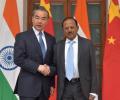
India and China have agreed to advance discussions on an "Early and Substantial Harvest" of boundary delimitation and border management during the 25th round of Special Representatives talks between National Security Advisor Ajit Doval and Chinese Foreign Minister Wang Yi in Beijing. Both sides reached an eight-point consensus, committing to the 2005 Agreement on Political Parameters and Guiding Principles for Settlement. Key outcomes include enhancing border management, improving understanding of the Line of Actual Control, establishing new meeting points and hotlines, and continuing cooperation on trans-border rivers and pilgrimage.

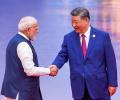
During the 18th BRICS Summit in New Delhi, Chinese President Xi Jinping and Prime Minister Narendra Modi held a bilateral meeting, outlining a four-point approach for the steady and long-term development of China-India relations. The leaders stressed strategic understanding, win-win cooperation, mutual respect, and inclusive multilateral engagement, reaffirming their commitment to resolving the boundary question and addressing economic concerns. They also discussed global challenges and strengthening people-to-people ties.

India on Tuesday conveyed to China the importance of maintaining peace and tranquility along the Line of Actual Control (LAC) for overall bilateral ties as national security advisor Ajit Doval held talks with Chinese Foreign Minister Wang Yi focusing on delimitation of the frontier and sustaining work on trans-boundary cooperation.

In July, tension emerged in Taksing, a remote village in the Upper Subansiri district of Arunachal Pradesh after locals sighted PLA soldiers.
India and China held diplomatic talks to review the situation along the Line of Actual Control (LAC), discussing boundary delimitation, border management, and trans-border cooperation. Both nations stressed the importance of maintaining peace and tranquillity for bilateral relations and agreed to continue using existing channels to resolve outstanding issues.

While tensions have eased at several friction points and mechanisms for managing the boundary have been reactivated, underlying differences persist. Disputes over naming practices in Arunachal Pradesh, continued infrastructure development on both sides, and unresolved questions regarding patrolling rights indicate that the structural gap remains, notes Dr Kumar.

The talks will focus on 'delimitation of the border, boundary management and a host of bilateral and international issues'.

India and China are in what experts call 'a cooperation-versus-competition situation'.

Chinese President Xi Jinping is in New Delhi for the 18th BRICS Summit, where he is scheduled to hold bilateral talks with Prime Minister Narendra Modi. This visit, his first to India in nearly seven years, comes amidst efforts to normalise India-China relations following the 2020 Eastern Ladakh standoff and is expected to have significant implications for bilateral ties and BRICS cooperation.

Foreign Secretary Vikram Misri held extensive discussions with China's Vice Foreign Minister Hua Chunying and other senior officials in Beijing, reviewing bilateral relations, trade, cultural exchanges, and emphasising peace and tranquillity in border areas. His visit aims to advance the vision of both nations as development partners.

National Security Advisor Ajit Doval is in Beijing for the 25th round of Special Representatives talks on the India-China boundary issue with his Chinese counterpart Wang Yi. These crucial discussions precede Chinese President Xi Jinping's anticipated visit to India for the BRICS summit, offering a potential opportunity for a meeting with Prime Minister Narendra Modi. The talks aim to address the long-standing border dispute and recurring tensions, with both sides emphasising the importance of peace and tranquillity for bilateral relations amidst recent reports of aggressive Chinese posturing in Arunachal Pradesh.

Against the backdrop of the war of words with China over Arunachal Pradesh, Prime Minister Manmohan Singh said on Monday, that India will "tackle" the boundary question with the neighbouring country bilaterally. Singh said this to a delegation from Arunachal Pradesh led by Chief Minister Dorji Khandu which requested him to review the defence strategy for the eastern sector in view of incursions by Chinese troops and other developments.

China and Bhutan held the 15th Expert Group Meeting to discuss boundary alignment, focusing on areas where there are no disputes, and agreed to maintain the momentum of negotiations.
This round of negotiations takes place three months after the last meeting of the special representatives in New Delhi indicating speeding up of efforts to resolve the boundary dispute.
National Security Advisor Ajit Doval engaged in Special Representatives talks with Chinese Foreign Minister Wang Yi in Beijing, focusing on the India-China boundary question and enhancing bilateral relations. These crucial discussions precede Chinese President Xi Jinping's anticipated visit to New Delhi for the BRICS summit, aiming to address persistent border differences and stabilise ties strained by past conflicts like the Galwan Valley clash.

Chinese President Xi Jinping's upcoming visit to India for the BRICS summit is a pivotal diplomatic event poised to significantly impact bilateral ties and global cooperation amidst ongoing international instability.

The boundary mess between India and Nepal needs a solution in a manner as mentioned by Nepal's Foreign Minister Shishir Khanal: 'On evidence not emotions', counsels Lieutenant General Shakti Gurung (retd).

Russian President Vladimir Putin stated that Moscow would not interfere in the "delicate" bilateral relations between India and China, expressing confidence in their ability to resolve border disputes amicably. He also discussed Russia's independent partnerships with both nations, touched upon India-Pakistan ties, and highlighted ongoing and proposed defence cooperation with India, including the BrahMos missile and a potential Su-57 fighter jet project.
National security advisor Ajit Doval arrived in Beijing on Monday for a two-day visit to take part in the Special Representatives talks on the India-China boundary question with his Chinese counterpart and Foreign Minister Wang Yi.

China emphasises proper handling of differences and a long-term perspective for bilateral ties ahead of President Xi Jinping's visit to India for the BRICS summit and talks with Prime Minister Narendra Modi. The visit aims to stabilise relations following the 2020 Ladakh standoff and strengthen BRICS cooperation.
At the two-day talks, which will conclude on Thursday, the Indian side is represented by National Security Adviser M K Narayanan while the Chinese side is represented by Dai Bingguo.

'The Chinese military cannot advance much in Ladakh, even if they want to.' 'Similarly, in Arunachal Pradesh, they can rename a village or two, intrude here or there, but cannot do much more realistically.'
A joint statement on the 'progress' of the talks would be made in Delhi.

'Xi is conveying that China is a pre-eminent power, and India should modulate its actions or approaches accordingly.'

Prime Minister Narendra Modi conveyed to Chinese President Xi Jinping that peace and tranquillity along the frontier remains an "essential" basis for the development of India-China relations, even as the two leaders welcomed "steady progress" in bilateral ties during their talks on the sidelines of the BRICS summit.

India and China held constructive talks on the situation along the Line of Actual Control (LAC) in eastern Ladakh, emphasising that maintaining border peace and tranquillity enabled progress in normalising overall relations.
Ahead of Xi Jinping's visit, National Security Advisor Ajit Doval and Chinese Foreign Minister Wang Yi held extensive talks in Beijing on August 25 on the boundary issue and reached an eight-point consensus.
The two sides have already held 21 rounds of talks under the framework of SR dialogue which was set up to find an early solution to the border dispute.

Phunchuk Stobdan's forte was candour and strong views on India's defence. Naturally, India's adversaries were in awe of him, fearing his views and unyielding stand on boundary issues, remembers Tarun Vijay.

The joint statement was issued during Pakistan Prime Minister Shehbaz Sharif's recent visit to China.
"The two sides have shown their positive political willingness and we are willing to work together with India so as to reach a fair and reasonable resolution framework acceptable to both at an early date so as to build a friendly and peaceful border area," Chinese foreign ministry spokesperson Jiang Yu said.

Gen Pande also said that Indian troops are adequately deployed along the Line of Actual Control to deal with any situation and that guidance has been given to them to "remain firm and resolute" in their tasks.

India is committed to finding an 'early settlement' to the vexed boundary issue: Swaraj
Chinese leaders for long have realised that territorial integrity within clearly defined borders is an imperative for national security and independence

Outlining seven principles of engagement for closer cooperation between India and China, Prime Minister Manmohan Singh on Thursday said the two countries should show sensitivity to each other's interests and sovereignty and move quickly to resolve the boundary issue.

India has firmly rejected Nepal's objection to the upcoming Kailash Mansarovar Yatra via the Lipulekh Pass in Uttarakhand, dismissing Kathmandu's territorial claims over the region.
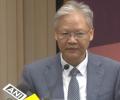
China firmly opposes the Trump administration's 50 percent tariffs on India as it is "unfair and unreasonable" and New Delhi and Beijing should scale up economic ties to jointly counter the challenge, Chinese ambassador Xu Feihong said on Monday.
